Why a Handle Can Tell You How an Object Wants to Be Used
A handle can signal how to hold, lift or turn an object. Learn to read its shape and placement before choosing the grip that suits the task.
The common mistake with a handle is to treat it as decoration around the useful part. That can make an object awkward to lift, turn or pass on, and can obscure the small design cues that explain its intended action. A handle is a quiet instruction: its shape, position and relationship to the object suggest what the hand should do.
Read the grip
Grip means the way a hand meets and holds an object. A loop invites fingers to curl through it; a knob asks for a pinch or a palm around it; a long bar offers room for one hand or two. These forms are not universal commands, but they make some actions easier to understand than others.
Placement adds another clue. A handle fixed above a container often suggests lifting, while one on a side may invite pulling or carrying. The material matters too: a smooth ceramic knob encourages a controlled touch, whereas a broad wooden grip can feel more suited to a firm hold. Neither shape alone settles the question; the object’s balance and opening matter as well.
Think of a handle as a doorbell button beside a door: its position and form help tell you what to do before anyone explains it. Unlike a label, though, a handle can communicate through the movement it permits. It turns an idea of use into a physical route for the hand.
Choose a grip style
There are three useful ways to read handles: by the action they invite, by the control they provide, and by the number of hands they accommodate. Each suits a different task, so the best reading begins with what the object needs to do rather than with which shape looks most familiar.
Loop for lifting
A closed or open loop gives fingers a place to hook under, making it a clear cue for lifting or carrying. A cup handle, for instance, keeps the hand away from the vessel’s body and allows the user to raise it without enclosing the whole object. This approach suits objects that need to be lifted repeatedly or held away from their main surface.
Loops also travel across cultures and contexts, but their meaning depends on proportion and placement. A small loop on a drawer may encourage a fingertip pull; a larger one on a basket can accommodate a whole hand. When the loop is narrow or crowded against the object, the invitation becomes less obvious.
Knob for turning
A knob concentrates the hand around one point. It often signals turning, pressing or pulling a small part, as with a cabinet door or a lid. This style suits a controlled action where the user does not need a long grip or leverage across a broad surface.
Its compactness can be useful where space is limited, but it gives less room for varied grips. A round knob may be easy to twist with a full hand, while a shallow one may invite a pinch. The shape offers a hint; the object’s resistance and the direction of movement complete the instruction.
Bar for pulling
A bar spreads the grip across a longer span. It commonly suggests pulling a drawer or sliding a door, and it can make the action legible from a distance because the hand’s position is visible. This approach suits heavier or wider objects, or situations where several fingers need a comfortable place to rest.
Bars also imply direction: a horizontal bar often encourages a straight pull, while a vertical one can support either pulling or pushing. That does not mean the form dictates a single use. It means the hand can approach the object with less guesswork.
Position changes the message
The same handle can communicate differently when moved. A loop placed centrally above a box suggests lifting it as a balanced whole. Put that loop near one edge and the box may tilt as it rises, making the grip feel more like a way to open or tip it than to carry it level.
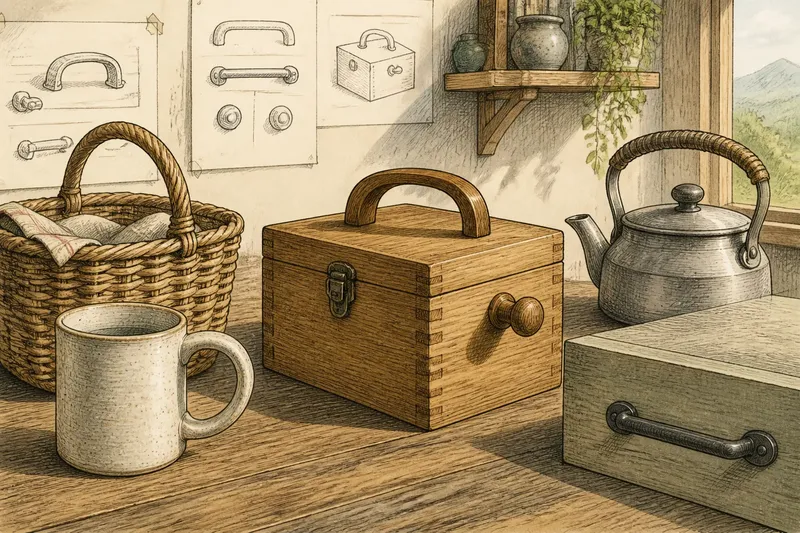
Imagine a small wooden storage chest with a centred top loop and a side knob. The loop invites someone to lift the chest; the knob suggests opening its lid. If the maker swaps their positions, a new user may first try to lift the lid by the loop and then discover that the side knob works better. The visible result is a moment of hesitation that comes from competing cues, not from a lack of intelligence.
Scale and balance can reinforce or contradict these signals. A large handle on a light object may make a firm pull seem appropriate, while a delicate attachment on a heavy object may discourage that action. The hand reads the handle alongside the object’s weight, centre of balance and moving parts.
Where do handle cues mislead?
Does a handle always reveal its purpose?
No. Handles can be reused, adapted or placed for reasons that are not obvious to a new user. Treat the form as a clue, then look at what moves, opens or supports the object before deciding how to act.
Why do similar handles feel different?
Material, thickness and distance from the object change how the fingers can settle. A metal bar may feel cool and firm, while a wrapped handle gives the hand a softer surface; these qualities affect comfort and confidence without changing the basic action the form suggests.
Can one handle invite more than one action?
Yes. A side loop might allow carrying, pulling or hanging, depending on the object and its surroundings. When several actions seem plausible, look for the one that keeps the object balanced and avoids forcing a moving part.
Choose by the task
For a reader comparing objects, the clearest choice is the handle that makes the needed action understandable and comfortable. A loop is a sensible cue for lifting or carrying; a knob suits a local turn or pull; a bar helps when a broader grip or straighter pull matters. The object itself should confirm the cue rather than contradict it.
Try a simple reading before using an unfamiliar object: notice where the handle sits, how the fingers can approach it, and which part seems likely to move. Then consider whether the grip would keep the object balanced. If the handle’s placement suggests one action but the object’s construction suggests another, pause and inspect the object rather than forcing the movement.
For designers and makers, the same questions can guide choices of form. A handle should give the intended user a comfortable place to meet the object, while its position should make the next movement easy to infer. The most effective handle does not need to explain itself aloud; it lets the hand understand what to try.
That quiet instruction is also part of how objects acquire meaning in different places. A familiar grip can carry an old habit into a new setting, while a changed placement can teach the hand a different action. To read a handle well, notice not only its shape but the movement it makes possible.