Port, Market or Workshop: Three Routes an Idea Can Take
Compare how ideas travel through trade, public markets and craft exchange, and see what changes as a design moves between makers, sellers and users.
The common mistake in tracing a travelling idea is to treat every point of contact as the same kind of exchange. A motif seen on a crate, a technique demonstrated at a market stall and a tool borrowed in a workshop may all cross between communities, but each route changes who can adapt the idea and what survives of its original use.
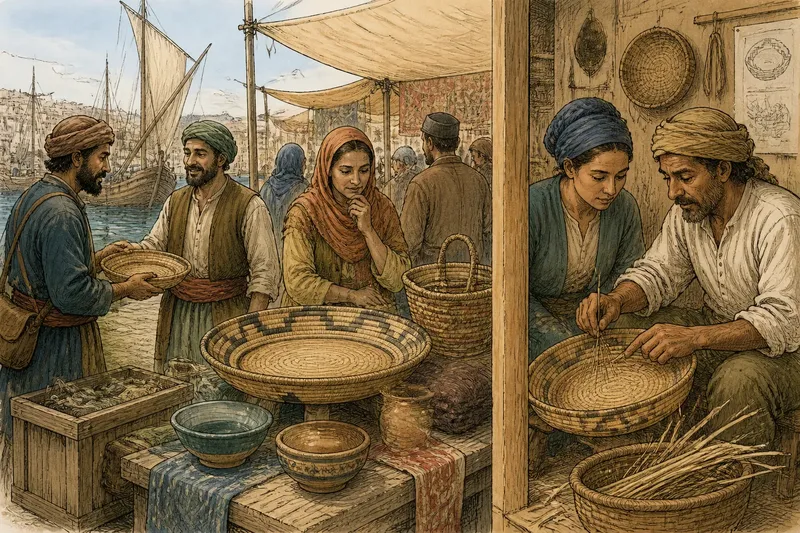
Consider an invented situation: a maker in the fictional inland town of Luma creates a shallow, woven tray with a distinctive stepped border. A trader carries one to the fictional port of Sera, where it is sold to a stallholder. The stallholder displays it at a public market, and a basket-maker from nearby Nemi later asks to learn how the border is made. The tray’s route gives us three different encounters: trade, public display and craft exchange. At each, the object and its idea acquire a different kind of audience.
Trade carries objects
Trade moves goods between people who may never meet. The trader in this invented journey can carry the tray to Sera, but need not know how its border was woven, what it was called in Luma or which tasks it served there. The object travels more easily than its explanation.
This separation matters. A buyer may value the tray for its form, durability or usefulness, while overlooking the decisions behind its construction. If the trader describes it simply as a serving basket, that description can become the version that circulates, even if people in Luma used it to sort dried leaves or carry sewing materials.
Trade also changes an idea through selection. Traders tend to carry what can be packed, transported and sold; fragile materials, complex forms or goods with little appeal to distant buyers may stay close to their makers. The objects that arrive elsewhere therefore do not represent everything made at their point of origin. They are a partial sample shaped by the route.
At Sera, the tray might prompt a local woodworker to copy its stepped outline in a carved rim, even without knowing how weaving produced it. That is an adaptation from observation, not a transfer of the original technique. A useful record of trade should therefore distinguish an object’s material journey from the knowledge that made it.
Markets invite comparison
A public market creates a different setting because objects appear alongside one another and their users can inspect them. At Sera, the stallholder places the Luma tray beside local baskets, glazed bowls and imported cloth. Visitors can compare shapes, ask about uses and make choices in view of other people.
That visibility can turn an unfamiliar object into a prompt. A customer might notice that the tray’s shallow centre makes small goods easy to see, while another admires the border. The market does not necessarily teach the construction, but it makes certain features available for discussion and imitation.
The seller also interprets the tray. A name, story or proposed use can help a customer understand it, but the seller’s account may simplify what is known. Even a well-intentioned description can connect the tray to a local use that differs from its role in Luma. Once a new use proves convenient, it may shape what later buyers expect the object to be.
Markets are not neutral stages: space, language, display and bargaining affect which ideas receive attention. A tray hung at eye level may invite close inspection; one stacked beneath other goods may be treated as ordinary stock. Buyers may also judge it by local preferences for colour, size or price, leading makers or sellers to alter future versions. In this route, the idea changes through public comparison and demand.
Workshops transfer decisions
Craft exchange goes further than seeing a finished object. When the basket-maker from Nemi visits a workshop in Luma, the maker can show how the border is formed, which strands are kept taut and where the weave must turn. The visitor encounters the sequence of decisions, not only the visible result.
Those decisions are often tacit knowledge: practical understanding communicated through demonstration, correction and repeated handling rather than through a written description. The visitor may learn that the border depends on a particular reed’s flexibility, or that a firm-looking edge comes from the order in which the strands cross. Such knowledge makes it possible to adapt the method rather than merely copy the shape.
Yet a workshop exchange is not a simple transfer from expert to pupil. The Nemi maker may use different fibres and have customers who need a tray to hold fish or market produce. The Luma maker might suggest a substitute material; the visitor may discover that a looser weave better suits local use. The resulting object can retain the stepped border while changing its scale, texture or purpose.
Credit and permission also matter. A visitor should ask whether a technique or design may be copied, taught or sold, particularly if makers treat it as shared community knowledge or reserve it for particular contexts. Respectful exchange includes listening to those boundaries, naming the source where appropriate and accepting that access to a finished object does not automatically grant permission to reproduce every aspect of it.
Where does the idea change?
What travels in trade?
Usually, the physical object travels most clearly; its name, use and making knowledge may travel only if someone carries or records them. Keep these parts distinct when describing an object’s route, rather than assuming that its appearance explains its origin.
What can a market teach?
A market lets people compare, handle and discuss objects, so it can spread preferences and visible features. It is less likely to convey a hidden technique unless a maker or seller explains it directly.
Does craft exchange preserve an original form?
It can preserve particular methods while changing materials or uses, because learners apply what they understand to their own circumstances. The result may be a related practice rather than an unchanged copy.
How can a visitor acknowledge a source?
Ask makers how they describe the object and whether they welcome copying, teaching or sale. Record names and permissions accurately, and do not present a local adaptation as though it originated with the visitor.
Following the invented tray
Return to the fictional tray from Luma. The trader brings its woven form to Sera, where a buyer uses it to display small goods. In the market, the visible border attracts attention, and the stallholder begins calling the form a display tray. Later, the basket-maker from Nemi learns the border technique in Luma, substitutes a locally available fibre and makes a deeper version suited to carrying produce.
Nothing in this account requires the tray to remain unchanged for its journey to count. The trade route preserves and relocates a particular object; the market route reshapes its public meaning; the workshop route passes on choices that can support new versions. Each connection carries some information and leaves other information behind.
If you are documenting a real object, a simple route map can keep those differences visible. Note where the object was made, who carried or sold it, where people encountered it, and whether anyone taught its construction. Mark what is known separately from what is inferred: a market label can show how a seller presented the tray, but not necessarily how its maker understood it.
Choose the route carefully
To understand how ideas travel, ask what each setting allows people to exchange. Trade moves goods across distance, markets bring objects into public comparison, and workshops make methods and decisions available for learning. These routes can overlap, but they should not be collapsed into a single story of influence.
For the hypothetical makers, the most useful next question differs by route. A trader might ask how the tray should be described; a stallholder might ask which local uses customers recognise; a workshop visitor might ask what may be adapted and how the source should be credited. Those questions keep attention on the people who carry, interpret and remake an idea, rather than treating its movement as automatic.
When you encounter an unfamiliar object, begin with the point of contact you can actually identify. A sales record, a market display or a maker’s demonstration each offers a different kind of evidence. That distinction makes the route clearer and leaves room for meanings that changed along the way.