The Pattern That Outlived Its First Purpose
A pattern that outlived its first purpose can carry old forms into new settings. Learn how to distinguish a surviving design from a surviving meaning.
The common mistake with a pattern that outlived its first purpose is to treat its familiar shape as proof that its original meaning travelled intact. That can turn a useful visual clue into a confident but unsupported story: a border on a contemporary cushion may resemble a mark once used to identify a community, yet resemblance alone cannot tell us what the cushion’s maker intended.
To read a pattern carefully, separate its visible form from the work it does now and the meanings people attach to it. Repeated lines, dots or leaves can preserve a recognisable design even as materials, makers, settings and audiences change. Which interpretation fits depends on what evidence is available and what question you are asking.
Start with the question
A pattern is a repeated visual arrangement: a motif, such as a leaf or zigzag, placed in a sequence or field. Its purpose is the practical or social role it serves in a particular setting. It might make a surface easier to recognise, mark belonging, organise attention or simply provide decoration. Those roles can overlap, and they can change.
Before settling on an interpretation, decide whether you want to know how the design was made, what it meant in an earlier setting, or how it functions today. These are related questions, but one answer does not automatically settle the others. A museum label, a maker’s account and the object’s visible construction may each speak to a different part of the story.
Think of a pattern as a tune played on a different instrument. The melody may remain recognisable while its tone and emotional effect change; likewise, a repeated form can survive while the material and social setting alter its meaning.
When the pattern is practical
If a design appears to help people use or identify an object, begin with the object’s task. Repeated bands can divide a surface into sections; contrasting marks can make an edge easier to see; a sequence might distinguish one group of goods from another. These are possible functions, not conclusions to infer from appearance alone.
Look for a close fit between the pattern and the object’s construction. Does a border follow a seam or rim? Are marks positioned where a user would handle, open, sort or inspect the item? Do they repeat in a way that seems suited to identifying parts? Such details can suggest how the design worked, while wear, repair or later decoration may complicate the reading.
Choose this practical reading when the question concerns use and the object offers relevant clues. Keep the claim modest: “the bands divide the surface visually” describes what can be seen; “the bands helped workers sort these goods” proposes a historical function and needs evidence beyond the bands themselves.
When the pattern signals belonging
Some patterns carry social meanings because people use them within a shared custom, group or setting. A motif may be associated with a place, a ceremony, a family or a form of membership. The association can matter greatly to those who recognise it, but it may not be legible to every viewer.
If the meaning is not explained by the object alone, look for accounts from people connected to the practice and for evidence about the particular object’s maker, owner or setting. A pattern’s resemblance to a familiar emblem is a starting point for questions, not a licence to assign identity. Similar shapes can arise independently, and a design may be borrowed, adapted or used playfully.
Where a pattern is connected with a living community, give weight to how people from that community describe its use. A broad claim about what a motif “has always meant” can flatten differences between families, generations and occasions. It is often more accurate to name who uses the pattern, in what context, and what remains uncertain.
When it becomes decoration
A design can continue after its original task or symbolism has faded, become less widely understood or been replaced. Its repeated form may remain attractive, familiar or easy to reproduce. Manufacturers, craftspeople and customers can then keep it in circulation for reasons that differ from those associated with earlier examples.
That change does not make a later use false or meaningless. A contemporary maker might value an inherited-looking border for its rhythm, connect it with family memory, or choose it because it suits a particular surface. Those are present-day meanings. They should not be silently substituted for an earlier purpose, but neither should they be dismissed as mere decoration.
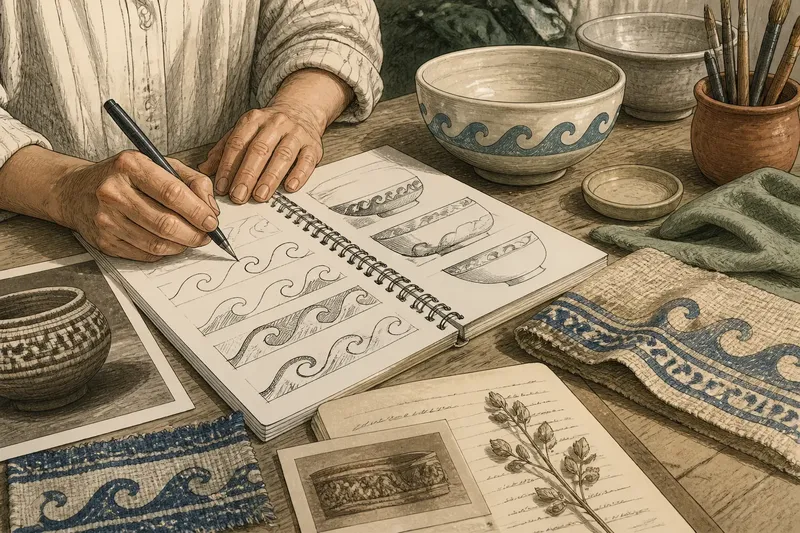
For example, say a ceramicist is choosing a repeated wave motif for a new range of bowls. The ceramicist checks the source of a reference image, learns that the image was associated with a specific community’s practice, and decides that copying it would imply a connection the maker cannot claim. The expected observable result is a design developed from the ceramicist’s own sketches, with the reference credited rather than presented as the source of the new motif.
When copying changes the story
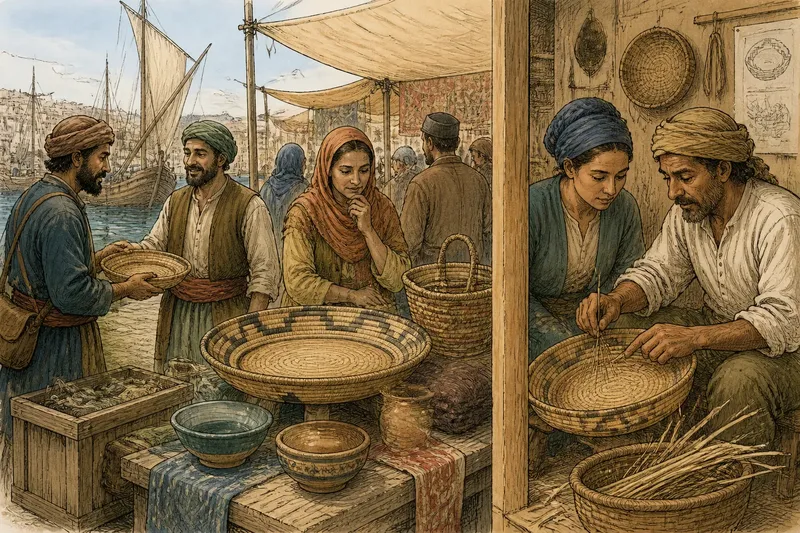
Patterns travel through many channels: trade, migration, imitation, teaching, printed designs and mass production. Along the way, a motif may be redrawn, simplified, combined with another, or detached from the object and setting in which it first appeared. The route matters because it can explain how a form reached a new audience without proving that its earlier meaning came along unchanged.
Compare examples by looking at material, scale, placement and the details of the motif. A woven border, a printed wrapper and a painted wall may share a visual feature yet use different techniques and serve different audiences. A small alteration can be significant, while a close copy may still carry a new meaning in its later setting.
When describing a borrowed design, distinguish what is visible from what is known: “the leaf forms resemble those in a textile from this region” is more careful than claiming direct descent without supporting evidence. If you can identify a documented connection, say what supports it and avoid extending that connection to every similar pattern.
Which reading fits?
What if the pattern has no known explanation?
Describe its visible features and where they appear, then leave its original meaning open. A missing explanation is not evidence that the pattern was purely decorative or that it carried a secret message.
How can I tell whether a motif was copied?
Look for specific correspondences, such as an unusual arrangement or a distinctive combination of elements, and compare them with evidence about contact between makers or communities. General resemblance is weaker evidence than a documented relationship.
Can a pattern keep its meaning after its use changes?
It can, for some people and in some settings, while others may encounter only its appearance. Ask whose meaning is being described and when it applies rather than treating one interpretation as universal.
What should I say when the evidence conflicts?
Set out the different accounts and identify what each one supports. If the object’s appearance points one way but a maker’s or community’s account points another, avoid forcing them into a single claim.
Choose your level of certainty
Match the strength of your wording to the kind of evidence you have. Direct observation can support a description of shape, colour, placement and repetition. A maker’s statement can clarify intention; a record tied to a particular object can support a claim about provenance or use. None should be stretched to answer questions it does not address.
- If only the form is clear: describe the motif and its arrangement without assigning an origin.
- If the object’s use is supported: explain how the pattern relates to that use and name the evidence.
- If a community account is available: attribute the interpretation to the people or setting it describes.
- If the design has travelled: distinguish the route of the visible form from the transfer of its meaning.
- If accounts remain uncertain: state what is known and leave the unresolved question open.
These choices are especially useful in captions, collection notes and classroom discussion, where a short sentence can turn a tentative interpretation into an apparent fact. If the item’s maker or source is unknown, say so plainly rather than filling the gap with a confident origin story. Where a label, maker’s explanation or local account is relevant, check it before presenting an interpretation as settled.
Read the present setting
Ask what the pattern does where it appears now. A repeated motif on a garment might help create a particular style, while the same arrangement on packaging could be used to make a product recognisable. These present functions do not erase an earlier history; they show that a pattern’s life has more than one setting.
Pay attention to who has the authority to explain or adapt a design, especially when it is linked to a living tradition. A commercial use, a personal tribute and a community-made object can carry different relationships to the same form. Naming those relationships is more informative than treating every reuse as either harmless borrowing or a direct continuation.
A pattern that outlived its first purpose is not an empty shell, nor is it a sealed message preserved unchanged. Its repeated form offers a thread to follow, but each claim about purpose or meaning needs its own footing. Start with what the object shows, distinguish earlier context from present use, and let the description stay as precise as the evidence allows.