A Small Object Display That Makes Room for Context
A small object display can keep travel keepsakes connected to their places and stories, with a simple arranging routine that avoids checklist clutter.
The most common mistake in a small object display is lining every travel keepsake up as if each one were a destination ticked off. The cost is not simply a crowded shelf: objects lose the relationships that explain how they came home, what they were for, or why they mattered to someone there. A small object display can make room for those differences by treating the arrangement as a changing conversation, not a complete inventory.
Begin with the remembered detail
Set aside a quiet morning to gather the objects you are considering, along with any notes, tickets, packaging or photographs that help place them. Do not start by sorting them into countries or arranging them by colour. Instead, recall one concrete detail for each: a stall beside a bus stop, a gift from a host, a material you had not handled before, or a conversation about how an object is used.
Write that detail on a temporary slip of paper. Keep the wording modest and precise. “Bought in the old quarter” says where; “the seller explained that this is used to carry spices” adds a connection between place, person and use. If you are unsure of a detail, mark it as uncertain rather than filling the gap with a confident-sounding story.
This first pass is about recovering context, not deciding what deserves display. A small, plain object may hold a more particular memory than a striking one, while a gift may carry a relationship that a souvenir bought for yourself does not. Keep both kinds in view before choosing.
Choose a small conversation
Later that day, choose a handful of objects that can speak to one another without pretending they are the same. The connection might be a shared material, such as woven fibre, or a contrast: an object bought in a market beside one received in a home. Avoid making a display that represents every stop on a journey. Completeness is not the aim; a legible relationship is.
Try placing the objects on a tray, a narrow shelf, or a piece of neutral cloth on a table. Leave visible gaps. Like arranging a few books for a conversation rather than stacking every book you own, the open space gives each item room to be noticed and lets the viewer move between them.
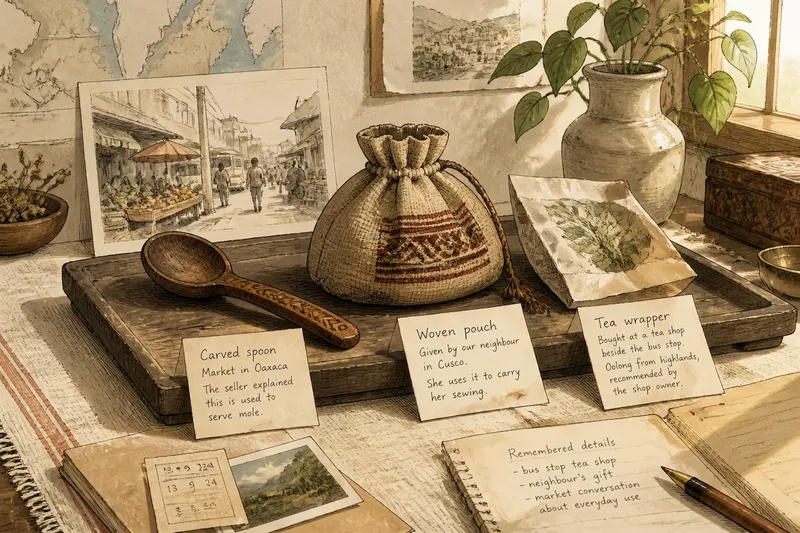
Say you have a small carved spoon from a market, a cloth pouch given by a neighbour, and a paper wrapper from a tea shop. Imagine placing the spoon near the pouch because both prompted a conversation about everyday use, while setting the wrapper slightly apart because it records a purchase rather than a shared custom. The expected result is an arrangement where the objects’ different routes remain apparent, rather than a row that implies they are interchangeable souvenirs.
Make origins legible
On the next day, add only the information a viewer needs to understand the relationships you have chosen. A small card can give an object’s name, the place you associate with it, and a short note about how it reached you. A handwritten label, a folded slip beneath a stand, or a note kept beside the display can all work; choose a form that does not compete with the objects.
Distinguish what you know from what you infer. “Bought at a market in Oaxaca” is a memory of acquisition; “made locally” is a claim about production and should be included only if you have a sound basis for it. The place where an object was sold, the place where it was made and the place where a practice began can be different. Keeping those distinctions visible prevents a display from turning travel geography into a simplified origin story.
If a maker, community or intended use is known, include it in plain language. If not, say what remains unknown or leave the label focused on your own encounter. The display can still hold meaning without supplying a complete account of an object’s history.
Adjust the arrangement
After a day or two, look at the display from the doorway and then from close by. From a distance, notice whether one object dominates or whether the whole group reads as a single category of “things from away”. At close range, check whether labels can be read without lifting or crowding the objects.
Move one item at a time. A change in spacing, height or direction may make a relationship clearer: a tag can face the viewer, or two objects can sit near one another while remaining visibly distinct. Do not arrange items to imply a shared maker, use or tradition unless that connection is part of what you know.
Use a stable surface away from direct sun and places where the display is likely to be knocked. For fragile, food-based or unusually made items, check the maker’s or seller’s care guidance before choosing a place; local rules may also matter for materials brought across borders. Keep the advice specific to the object rather than applying one cleaning method to the whole group.
Keep the display open?
How many objects should I include?
Choose only as many as can be seen and understood together in the space available. If the objects compete for attention, remove one or rotate it into storage rather than squeezing the group closer.
Should I group keepsakes by country?
Use geography when it helps tell the story, but do not assume that a national label explains an object’s making or use. Grouping by a more specific connection, such as a shared material or a difference in how each object came to you, may preserve more context.
What if I do not know an object’s origin?
Record what you can verify, such as where you received or bought it, and leave its production history open. A careful “origin unknown” is more informative than assigning a place from appearance alone.
Can I include photographs or tickets?
Yes, if they clarify a particular encounter rather than decorate the display with general travel imagery. Keep paper items slightly apart from delicate objects and choose a display position that protects them from strong light.
Refresh without erasing
At the end of the week, take a photograph of the arrangement and keep the temporary notes with it. The photograph records how the objects related at this moment; it need not become a permanent catalogue. If you move or rotate an item, keep its note so that changing the display does not erase the story you recovered.
When a new keepsake arrives, let it sit beside the existing group for a while before deciding whether it belongs. Ask what connection it adds and whether that connection is genuinely known. If it brings a different voice or route, a separate small arrangement may be clearer than forcing it into the current one.
A small object display works best when it leaves room for what is still uncertain. Keep the objects’ paths distinct, name the links you can support, and allow the gaps to carry part of the meaning. The result is not a checklist of places visited but a modest record of encounters that can change as your understanding does.